
'Disappointed' Derbyshire residents react after inspector allows 135 homes in countryside near town
A Government inspector’s decision to approve an appeal for more than 100 homes in the countryside around a Derbyshire town has been dubbed “disappointing but unsurprising”.
Plans from land agent Richborough Estates for 135 houses in Kings Newton Lane, Melbourne, have been approved following an appeal and public inquiry.
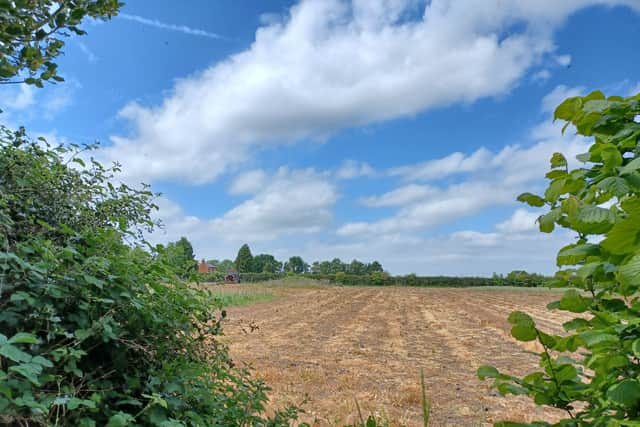

The scheme had been taken straight to appeal by Richborough before councillors could make a decision last year. Richborough said the council had taken too long to make a decision.
Instead, council officers rejected the scheme so that the appeal inspector would have the authority’s views on record.
More than 100 objections were filed by opposing residents, a number of whom spoke at the November inquiry in Swadlincote, along with opposition from Melbourne Parish Council, the Kings Newton Residents’ Association and Derbyshire CPRE (Campaign to Protect Rural England).
Their concerns focused on the impact on the landscape, the separation between Melbourne and King’s Newton, construction outside the settlement boundary, overdevelopment, the loss of agricultural and market garden land, the impact on infrastructure, including roads, and the shortage of supporting facilities.
Part of the site is the only known plot in the whole district which is rated Grade 1 agricultural land – the highest quality – which the inspector said is “scarce” nationally.
Cllr Amy Wheelton, a district councillor, spoke during the hearing to say 52 per cent of the land was grade one and 45 per cent was grade two.
The inspector said grade two was also “scarce” nationally, but “not uncommon” in the district.
In his decision, Government inspector Gareth Jones, countering arguments about the need to protect “scarce” high-quality agricultural land, wrote: “There is no evidence to suggest that the UK faces a food security crisis.
“Best and most versatile agricultural land is not the only land on which crops can be grown. It is simply land which is of better quality
“Given its relatively modest size, from the information before me, there is no reason to believe that the loss of the site to another use would have a significant effect on agriculture/horticulture at a national or local level.”
A series of complex debates between the council, developer and inspector have resulted in Mr Jones ruling that the authority does not have enough homes planned in the district to meet its mandatory five-year land supply.
This is a key metric used by councils and developers to work out if more homes could be required or sustainable in the area.
Mr Jones said that because nearly a quarter of the district’s future housing blueprint is actually overspill for the area catering for Derby’s shortfall, this 24 per cent proportion of homes should be discounted.
Ultimately, this leaves the district without sufficient homes to meet its own targets, when excluding those being built to help Derby meet its target.
Mr Jones writes: “The proposed development would bring a range of benefits, most notably the delivery of significant amounts of market and affordable housing in an accessible location with reasonable access to a range of services and facilities.
“Given the area’s current housing delivery circumstances, the benefits together carry substantial weight in favour of the appeal
“There are a number of adverse impacts that would result from the proposed scheme, including the harm to the character and appearance of the area, the loss of BMVAL and the associated development plan policy conflict.
“There is also the conflict with the area’s strategy for the location of development. However, in the context of there currently being no framework compliant housing land supply this latter matter carries limited weight.
“These adverse impacts are collectively weighty. Nonetheless, they fall well short of significantly and demonstrably outweighing the benefits, particularly those associated with affordable and market housing delivery.”
Richborough Estates was approached for comment but has not responded as of this article’s publication.
Frank Hughes, a Melbourne resident who spoke at the inquiry, said: “This is a very disappointing outcome for many of us who objected to the planning application and spoke at the appeal hearing. The inspector appears to have given little weight to the arguments put forward by residents and by the district council in defending their initial decision to refuse permission.”
In the inquiry he had said the scheme would be the “biggest single development in our villages” and would “steamroller over” the wishes of the community.
Cllr Matthew Gotheridge, a district councillor for the area, said: “On a personal level, I find this news very disappointing. I believe Melbourne has been significantly overdeveloped in recent years, and even within my 27 years of living here I have witnessed considerable change.
“Housing has been built wherever possible, often without the supporting infrastructure keeping pace, which I believe has had a negative impact overall.
“I know many residents who hold strong views on this development will feel equally disappointed by the Inspector’s decision.
“That said, I also recognise that some people will welcome this outcome, those who believe that development is a necessary and healthy part of a growing community.
“There are always differing views on matters such as this, and that balance of opinion is an important part of a healthy democracy.
“We are all entitled to our perspectives. I hope to be able to meet with the developers to see if there are any positives that can benefit the community.”
Cllr Charlotte Hill, Derbyshire county councillor for the area and the authority’s cabinet member for highways, said: “The news of the appeal decision is very unfortunate but unsurprising to me, as the Labour government have proposed a large increase in mass developments, by aiming to build 1.5 million homes in their five-year term, the East Midlands Mayor also is committing to building 100,000 new homes.
“Since 2011, South Derbyshire has only seen 21 per cent of developments built on brownfield sites, meaning over 8,000 houses have already been built on greenfield sites that are now lost forever.
“We need to protect our countryside while preserving local community identity.
“This is an example of Melbourne Neighbourhood Plan being ignored, green fields being concreted, and the inevitability of villages being joined up by overdevelopment. But, most importantly, Melbourne residents have been ignored.
“Melbourne needs a care home for elderly resident provisions, more secondary school places, assistance to ease the pressures on the local doctor’s surgery and, overall, more infrastructure.
“I hope to see that now this development has been approved, as a minimum, the developers should use local businesses, and I encourage the developer to work with South Derbyshire Construction College to take the opportunity to provide key work experience to local apprentices.”