
‘Cave where hermit lived in one of England’s smallest churches is my favourite hidden Derbyshire gem’

Discover the hidden gem’s fascinating history of solitude and prayer that shaped its creation.
The quirky county of Derbyshire is filled with rich and interesting heritage.
One of my favourite places is a hidden gem in Derbyshire.
Hermits Cave at Dale Abbey is one of the quirkiest spots in not only the county - it is also considered to be England’s ‘smallest church’.
There is a fascinating history behind Hermits Cave.
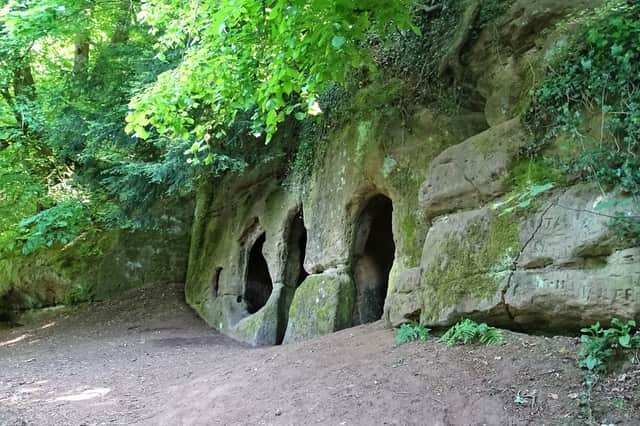

It is based in the small Derbyshire village known today as Dale Abbey.
It had a different name centuries ago, where locals called it Depedale, being renamed after a monastery in the 13th century.
Being the site of a monastery meant it was a spiritual site, however we need to travel back further to uncover a truly fascinating tale.
Depedale’s first religious occupant was a hermit seeking solitude in the early 1100s.
The hermit undertook a massive life change, switching from a busy, full-on life as a baker, to becoming a hermit.
What caused this massive life change?
Legend has it that the ex-baker-turned-hermit had a dream that the Virgin Mary urged him to travel to Depedale to lead a life of solitude filled with prayer.
The inquisitive baker promptly hung up his baking gloves and trekked to Depedale, despite not really knowing where the exact location was.
When he came across unoccupied marshland, whose only defining feature was sandstone banks, he set to work.
He had to make his dream come true - quite literally - and so he started excavating a residence in the sandstone formations.
What he eventually created is truly jaw-dropping.
A cave took shape and he managed to fashion one of the simplest places of worship.
The hermit carved holes for windows, doors and a cross to begin with, adding a tiny chapel at the site measuring just 26ft by 25ft.
This undoubtedly makes it one of England’s smallest churches.
The hermit worked hard to make the site as self-sustaining as possible, even creating a well outside that is visible in the adjoining churchyard.
Today the church’s roof also forms a covering for a nearby farmhouse, which may have been used in the past as an abbey infirmary.
It is astounding to think how actions of those who lived centuries ago, impact the lives of people today. This is why Hermits Cave at Dale Abbey is one of my favourite hidden gems in Derbyshire.
Thanks to the hermit getting handy with his tools and acting on his dreams in 1130AD, Depedale became a well known site of religious worship.
The site’s cultural significance was augmented by Augustinian canons establishing a monastery on the site in the 13th century.
Other religious occupants over the years include Premonstratensian canons.
Although the abbey was largely destroyed in the 16th century when Henry VIII's Dissolution of the Monasteries came to pass, the church with stunning stone arch remains, hidden deep in Derbyshire woods.
Did you know, you can now upload news about your business directly to the DerbyWorld news team by clicking here?