
Derby house clearance: Proof German troops sang 'God Save The King' before WW1 Christmas truce football match
An unseen diary recounting the legendary First World War Christmas truce football match reveals German troops sang 'God Save The King' as a gesture of goodwill. The remarkable wartime album was recently found in a during a house clearance in Derby.
It was said that soldiers from both sides put aside the war for Christmas 1914 and played a football match in no-man's land.

A newly unearthed diary by a British soldier has revealed incredible details leading up to the iconic game – including German troops singing ‘God Save The King’ in English.
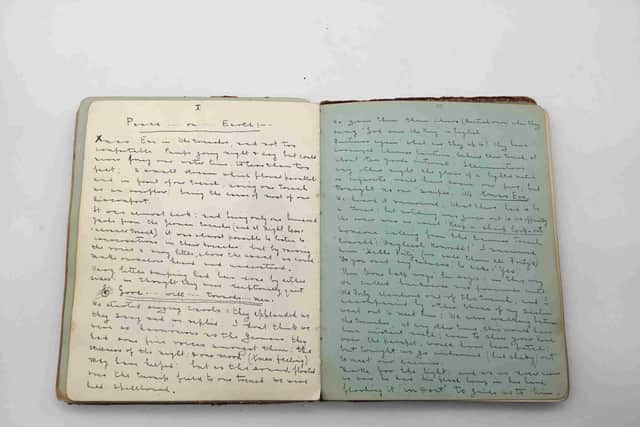
Scottish soldier John J Ferguson, from the Seaforth Highlanders, wrote: “Xmas Eve in the trenches and not too comfortable.
“It was almost dark and being only 100 yards from the German trenches it was almost possible to listen to the conversations...very little sniping had been done by either side, we thought they were exceptionally quiet. Good ... Will … Towards … Men.
“We started singing carols. They applauded us. They sang and we replied. I don't think we were as harmonious as the Germans.
“They had some fine voices among them. The stillness of the night, our mood (Xmas feeling) may have helped but as the sound floated over the turnip field to our trench we were held spellbound.
“We gave them three cheers (British ones) when they sang ‘God Save The King’ in English.
“Quietness again. What are they up to? They have arranged Chinese lanterns behind their trench…Illuminations any other night would have drawn out fire but tonight no-one snipes, it's Xmas Eve.
“We hear it rumoured that there had to be a truce but nothing was given out to us... Someone calling from the trenches 'Ongleesh Komadd’.
“I answered him 'Fritz' (we call them all Fritz). ‘Do you want any tobacco?’ he asks. ‘Yes’. 'Then come half ways’, he says.
“In this way we called backwards and forwards until Old Fritz clambered out of the trench and I, accompanied by another three from my section, went out to meet him.
“We were walking between the trenches. At any other time this would have been instant death, even to show your head above the parapet would have been fatal.
“But tonight we go unharmed (but shaky) to meet our enemies.
“Make for the light and as we drew near we saw he had a flash lamp in his hand.
“We shook hands, wished each other a Merry Xmas and were soon talking like old pals, standing in front of their wire entanglements and surrounded by Germans.
“We stood in the circle of Germans like street-corner orators. Soon most of my company, hearing I had gone, followed us.
“What a sight it was, little groups of Germans and British extending almost the length of our front.
“Out of the darkness came laughter and talking, lighted cigarettes and the flash of matches.
“Germans and Seventh lighting each other's cigarettes and exchanging souvenirs.
“Here we were laughing and talking to men whom only a few hours earlier we were trying to kill.
“I was surprised at the good English, especially of Fritz. He told me he had been doing business in Edinburgh and west of Scotland and only left in August when called up. He knew our regiment well and had seen them in Edinburgh Castle.
“They had arranged not to fire for 48 hours but warned us the Prussians on their left would still be sniping.
“They kept their word and neither of us fired for two days. It was like being in a different world. Here we were, Christmas Day in the trenches and able to walk about with our heads up.
“Some of our men even left the trench to play football - a party from our 'B' went over and were photographed with the Germans... We had made friends with the enemy and all day kept calling and joking across the trenches.”
Tragically, on Boxing Day – hours after the festive truce ended – soldier John was badly injured while fighting in Messines, Belgium.
He wrote: “Dec 26 a shell struck me. Left arm amputated at elbow and shrapnel wound left thigh.
“In all I had six pieces of shrapnel and two bullets removed but I knew it was not our new friends, the Bavarians, who shot me but the artillery of the Prussians.”
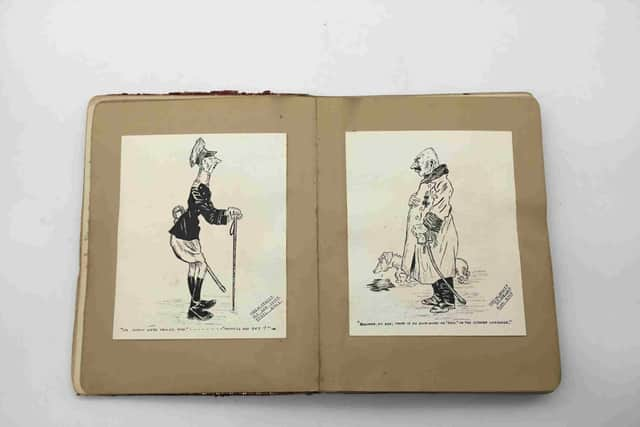
The eight-page account was in an album of diary entries, poems and drawings, collected by Red Cross nurse Maude Alice Lineham.
While working at Derby’s Spondon House Hospital, Derbyshire Royal Infirmary and Leicester Royal Infirmary, she encouraged around 90 soldiers to share their memories to aid their rehabilitation.
Maude died in 1965 aged 82. Her remarkable wartime album was recently found in a during a house clearance in Derby.
It is set to fetch between £400 and £600 when it goes under the hammer at Hansons Auctioneers on November 13.
The album also includes a piece of German white flag taken from a POW in France on May 17, 1915.
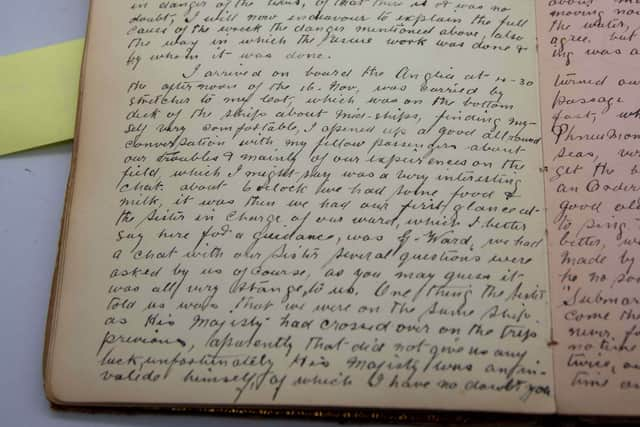
Meanwhile a soldier called C Gordon, of the 9th King’s Royal Rifles, wrote about the sinking of HMHS Anglia which struck a German U-boat mine killing 134 men.
The vessel was carrying 390 injured soldiers from Calais to Dover on November 17, 1915, when it sank in just 15 minutes.
The diary reads: “All the life boats were full of men, the men from below. No one seemed to give any instructions.
“‘No one seemed to know what to do. The ship's crew were not to be seen anywhere.
“The men in the lifeboats didn't know how to lower the boats.”
Maude had been school teacher before becoming a voluntary aid detachment nurse at the outbreak of war.
Her album was found in an earlier house clearance and the current owner inherited it from his mother.
The 75-year-old seller said: “I tried to find any relatives of Maude’s as I knew they would appreciate it, as I did.
“World War One nurses encouraged patients to write about their experiences as part of their recuperation.
“Maude’s album is particularly delightful as it is so complete and she showed such diligence in making sure the young men in her charge recorded something, either by the written word or a beautiful picture.”