
Derbyshire roads are among the 'worst in England' - here's what the council says

Derbyshire was beaten by Southend-on-Sea, a resort town in Essex
A new study delving into road maintenance has revealed areas in England with the worst roads - and Derbyshire is number two on the list.
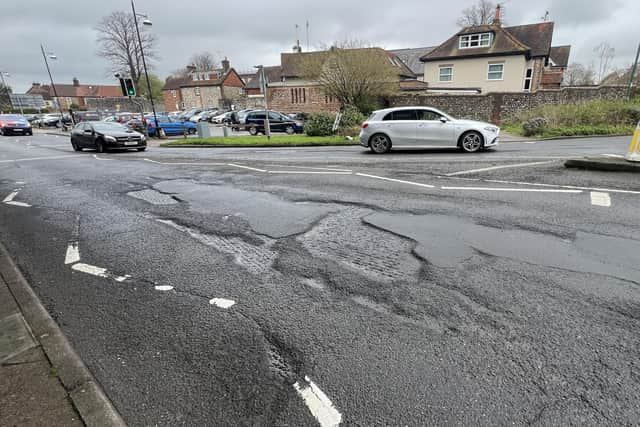

Car check company Motorscan analysed data from the Department for Transport which showed historical road condition statistics for every English local authority.
Motorscan say research is based on the average percentage of roads requiring maintenance between 2018 and 2023.
It found that statistically, the Southend-on-Sea area has the worst roads in England.
This is because the area has an average percentage (of B and C roads requiring maintenance) of 24.6% between 2018 and 2023, the highest of any area in England.
This, combined with 15.6% of A roads requiring maintenance in the same period, means that it comes in as the area with the worst roads in England.
Derbyshire came in second place on the list. Between 2018 and 2023, 14.7% of A roads were judged to require maintenance on average, and in the same period, 21.2% of B and C were also found to need maintenance in the East Midlands local authority.
The local authority for the city of Derby came fourth on the list. Motorscan says 9.7% of A roads required maintenance between 2018 and 2023, with more issues for B and C roads, where 14% required maintenance on average.
Here is the full list of areas that have the worst roads in England
1. Southend-on-Sea
2. Derbyshire
3. Hackney
4. Derby
5. Newham
6. Lambeth
7. Brent
8. Hammersmith and Fulham
9. Shropshire
10. Liverpool
Oliver Thompson, Head of Vehicle Intelligence at Motorscan, said: “With these results featuring areas from many different parts of the country, it shows that road maintenance is an issue all over.
“While poor road maintenance can mean issues for your car, with risk of damage being done, it can also have a big effect on road safety as well.”
Derby World contacted Derbyshire Council for comment.
Read more: What's On in Derby?
Councillor Charlotte Cupit, Cabinet Member for Highways Assets and Transport said: “Like many surveys of this kind, the reality is you’re comparing very different areas which gives a very distorted picture. Things are never that simple so these figures and areas aren’t comparable.
“Unlike the other local authorities included in the survey data, we survey our roads differently, to meet the specific needs of our extensive rural, unclassified road network and to help us accurately check and prioritise the condition of each road for funding. This is noted in the Department for Transport’s data but is often overlooked by companies looking for a news story.
“Here in Derbyshire, we maintain more than 3,500 miles of roads - a much bigger road network than a city or small London borough. We care for roads in the High Peak, with a much colder and wetter climate than areas in the south of the country, which takes its toll on the lifespan of the road surface.
“Our geography and geology is very different to other areas, with heavy rainfall causing over 200 landslips across the county and we have to maintain 1000km of retaining walls which hold up key roads like the main A6, along the River Derwent.
“Recent exceptional weather conditions, including last October’s Storm Babet, brought a month’s worth of rainfall in a matter of hours. On top of this, we’ve had double the usual rainfall over recent months, as well as the longer-term challenge of ageing highways and reducing comparative investment over recent decades.
“We are doing everything we can to make the money we get go as far as possible. This has included a £120 million capital programme of road resurfacing over the last three years, which these statistics don’t reflect, and a planned further £27 million capital programme this year. This month, despite the significant budget challenges facing the council, we’ve invested extra money to tackle pothole repairs as we recognise this is an important issue for our communities.
“We’re also bumping up our resources to fill more potholes and be able to do shorter sections of resurfacing in hotspots. We’ve got up to 25 reactive teams who have been filling over 2000 potholes a week since the start of the year, and have as many teams as possible out 7 days a week. We’ve also got extra teams out working on sectional resurfacing, and we’ve already carried out resurfacing repairs on more than 100 hotspot sites over recent months.
“We are also strongly making the case to the Government at all levels to highlight the challenges we’re facing and push for additional investment. We will continue to do this and hope the Government will support us in this soon.”
What are your thoughts on roads in Derby?
The condition of roads continues to be an emotive topic that shapes the manifestos of both incumbent government and opposition parties.
The Conservatives’ 2019 manifesto pledged a ‘massive programme of improvements for our roads’ while Labour says they will prioritise roads under ‘Get Britain Building Again’ as part of its Five National Missions featured in their 2024 manifesto.
We are keen to hear from Derby residents about their thoughts on roads in their area. Are you happy with the maintenance or do you think improvements could be made? Get in touch with us by emailing [email protected]