
Discovery of 3,700-year-old Derbyshire Bronze Age site 'will not affect holiday park plans'
The recent discovery of a Bronze Age site in Derbyshire is not expected to affect the plans for a new holiday park in the area.
Forestry England is confident the discovery of a ceremonial site dating back to the Bronze Age on moorland near a Derbyshire town will not stop ongoing proposals for a woodland holiday park.
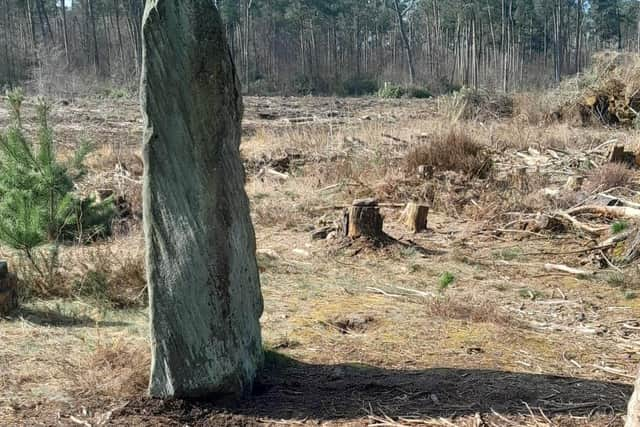

The Save Farley Moor campaign hopes the discovery near a single standing stone monument at Farley Wood, near Matlock, will help to stop a Forest Holidays’ planning application to build 75 cabins in 140 acres of woodland at Farley Moor, off Farley Lane, near Matlock, which is being considered by Derbyshire Dales District Council.
However, Forestry England – which operates as the landlord to Forest Holidays – says it is confident the ceremonial circle will be unaffected by the holiday park scheme’s site despite campaigners’ concerns and their ongoing claims that the scheme will also create a loss of trees and wildlife and an increase in traffic problems.
A Forestry England spokesperson said: “Following recent excavations at the Farley Moor Standing Stone, we are confident that it will remain unaffected by our proposals for a Forest Holidays’ location. The standing stone lies outside of the proposal, and its preservation will continue.
“The wider landscape that surrounds the monument has been forested for approximately 50 years, meaning that the prehistoric landscape to which the site was originally connected has long since been altered. As a result, the proposals will not affect the setting or historic landscape character of the site.”
Campaigners highlighted the ceremonial circle after TV’s Time Team archaeologists confirmed that the 6ft 6ins tall Farley Moor standing stone monument, at Farley Wood, near Matlock, is part of a larger ceremonial site dating back 3,700 years to the Bronze Age.
The archaeological discovery was recently featured on Time Team’s YouTube channel after it was found during excavations by Forestry England in partnership with the Time Team crew.
Forestry England stated that excavations uncovered evidence of a ceremonial platform nearby and identified that five other nearby stones would have once been standing to form a circle with the main stone located above a natural spring and it will continue to protect and manage this area as though it was a scheduled monument.
Campaigner Kitty Kenyon hopes the discovery which she says is less than 100m from the proposed holiday development will have a bearing on whether the scheme goes ahead or not.
She said: “Time Team have demonstrated that Farley Moor is a significant, sacred, Bronze Age archaeological site which needs to be protected at all costs.”
But a Forestry England spokesperson explained that as part of the planning application process an archaeological assessment was carried out which noted the presence of the standing stone but no other known sites or monuments were recorded within the proposed holiday park scheme area.
Derbyshire County Council has also assessed the proposed holiday park scheme, according to Forestry England, and has raised no objections on heritage grounds.
The Forestry England spokesperson added: “Based on this we are confident we can take the appropriate mitigation measures to account for these and any other unknown features, as is normal within the planning process. Such measures typically include watching briefs, archaeological monitoring and other forms of investigation, as necessary.
“More broadly, our proposals provide opportunity to further share and interpret the rich history of the area.
“Our ongoing research demonstrates how dynamic this landscape has been over millennia, shaped by different influences and evolving through time. We see this development as an important new chapter in the landscape’s history, one that will support improved management, public engagement and appreciation of the site’s significance.”
Plans for the scheme include nine one-bed cabins, 35 two-bed cabins, 22 three-bed cabins, five four-bed cabins and four five-bed treehouse cabins to accommodate 185 people, a car park, reception, shop, cafe, maintenance building and outdoor play area, a ranger station, storage pods, recycling points, ancillary roads, paths, and an archery range.
But many residents and campaigners, including over 3,000 who have signed a petition against the scheme, have already raised a number of objections to the scheme.
These include concerns about potential noise and light pollution, increased traffic congestion, road safety, access, loss of trees and wildlife, the disturbance of land releasing peat into the atmosphere, flooding and surface run-off water from the scheme, and the over-saturation of the area’s holiday market.
Derbyshire Wildlife Trust has raised concerns for birds and badgers, with the scheme’s foul water, and an expected loss of forestry, woodland and grassland but the applicant has stated that it intends to implement a habitat and creation and enhancement scheme to address losses.
The Council for the Protection of Rural England has also objected to the scheme claiming there is insufficient infrastructure and the Clean Rivers Trust has objected over concerns about a feared threat to others’ water supply.
Darley Dale Town Council has also objected with concerns about light pollution, highways, the impact on the environment and limited infrastructure but Matlock Town Council, Natural England and Derbyshire County Council’s Highways department have raised no objections.
Forest Holidays has stated the scheme will create new jobs and be sensitive to the environment with a management plan for a more diverse forest canopy with some necessary tree removal to minimise blight infection and it claims there will be an enhancement to change the woodland from coniferous pine to a more continuous cover, native woodland.
And Forestry England says it has been advised the development will have no adverse effect upon the highway and no safety concerns are expected and enhancements have been proposed at an access point off Farley Lane.
Forestry England has also previously claimed overall proposals have been designed to deliver ‘biodiversity net gain’ and there will be ‘no adverse impact or loss of habitat’ and lighting will be carefully considered.