
'We’re carefully repairing a 2,300-year-old Egyptian mummy - now he's returning to Derby'
Students from the University of Lincoln have undertaken conservation work on Pa-Sheri, a 2,300-year-old Egyptian mummy, giving it a new lease of life before its return to Derby.
Students have been carrying out repairs to a 2,300-year-old Egyptian mummy following centuries of damage as part of their university course.
The mummified man, known as Pa-Sheri, lived around 300 BCE during Egypt’s Ptolemaic period and came to Britain during the 19th century.
Since at least 1859, he has been part of a collection at Derby Museums, who sent him to the University of Lincoln for conservation work.
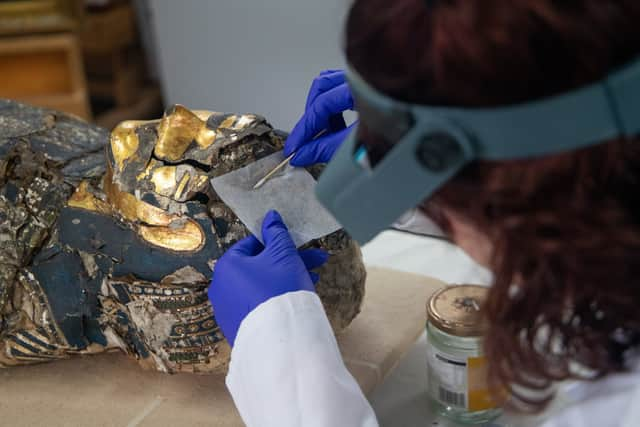
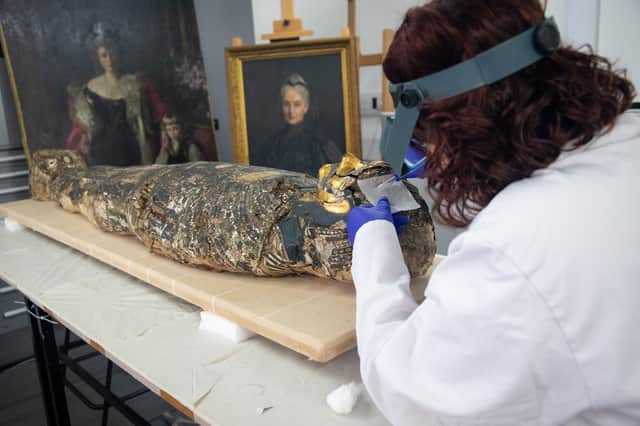
Student conservators have since been working on repairing the mummified remains in a lab to give it a new lease of life and preserve its history.
During the 19th century, it was common for mummified people brought to Britain to be unwrapped and 'examined'.

However, legend has it that a curse is alleged to be cast upon anyone who disturbs the mummy of an ancient Egyptian.
Undeterred students Ella Maude and Ella Monteiro have been working on Pa-Sheri with senior technician Josephine Mackenzie.
The university said Pa-Sheri’s intricately painted cartonnage and gilded mask suggest high social standing in ancient Luxor.
But a "very different story lies beneath" - which was shaped as much by Victorian curiosity as the rituals conducted after his death.
In Pa-Sheri’s case, this included the removal of his head, pelvis, parts of his limbs, and the rearrangement of arm bones into his chest cavity.
His outer wrappings were then reattached, concealing the invasive treatment until the museum undertook x-rays which revealed his true condition.
Ella Monteiro said: “Working on Pa-Sheri has been a very personal and humbling experience.
"His journey has been long and tasking, and to conserve him is to become a part of his story.
"The work we are doing with Derby Museums ensures his legacy lives on and his story continues to be shared with the world.”
Ella Maude added: "This project has been an incredible learning experience.
"Our aim has been to protect him as he is now, respecting both his original context and the history that has followed.
"Despite his removal from his original burial place, I hope that our work helps to safeguard Pa-Sheri’s continued afterlife.”
The team said they were taking a "minimal intervention" approach rather than restoring Pa-Sheri to an imagined original state.
They have been stabilising areas of damage while preserving the evidence of his unusual post-mortem journey.
The hands-on work includes consolidating the flaking plaster and paint layers, cleaning the fragile surfaces using gentle techniques, as well as replacing aged supports beneath Pa-Sheri’s mask with safer, more durable materials.
The project, funded by the Pilgrim Trust, is also said to be shedding light on ancient craftsmanship and Victorian-era interference.
Through polarised light microscopy, the team identified vibrant pigments like Egyptian Blue, orpiment yellow, and both red and yellow ochres, whilst UV light analysis also revealed the use of animal glue used during the 19th-century reassembly.
Josephine Mackenzie, senior conservation technician at Lincoln, said: "This project has offered the students a unique opportunity to engage with a complex conservation challenge.
"Pa-Sheri represents a rare case study, illuminating not only the materials and techniques of his period but also the evolving history of collecting and conservation practices.
"Our responsibility is to preserve him with the highest level of respect, acknowledging both his original cultural context and the ways in which his story has been reframed over subsequent centuries.
“By adopting a careful, minimal-intervention approach, we safeguard the object’s integrity while retaining the evidence of its lengthy historical journey.
"It is gratifying to know that this work will directly inform the museum’s forthcoming exhibition and enhance public understanding."
Laura Phillips, head of curatorship at Derby Museums said: “It has been a pleasure continuing our long-term partnership with the team and students at Lincoln.
"Arranging the appropriate care for Pa-Sheri is a challenge and whilst this essential conservation takes place, we know he is in safe and caring hands.
“Derby Museums promotes skill sharing and career development opportunities whenever possible and is committed to supporting students to engage with our collections through partnerships like this”.
After conservation, Pa-Sheri will return to Derby Museums to be displayed alongside another mummified individual, Pypyu, in a new exhibition.